A recent post on Doug Rose's great blog (Doug Rose Fly Fishing Blog) got me reminiscing about fly fishing out at Swiftsure Bank.
I've been thinking about what made Swiftsure so special for me. As I look back I don't think it was solely about numbers of fish. One can find large numbers of salmon much closer to port and without the pounding the kidneys took from the long run straight into the swells made steeper by the strong currents draining Puget Sound.
What made Swiftsure such a special place was the total package, which started with the base of the food chain. The tiny krill is the base of the food chain out there and created the sights and sounds that made the fishing so wonderful. There were many days where the krill were non-existent and the fishing was excellent drifting around blind casting flies. While fun, those days were missing the total Swiftsure package.
The total package began with the krill but needed other ingredients to make an exceptional day. You needed to find the krill and there were really two ways to find them, birds or whales. Both required keen eyesight to spot on days with good visibility. Foggy days are common offshore and finding them with no visual cues made discovering them even better. I remember watching the depthfinder as one approaches the bank. The depth slowly shallows to around 300 feet and the search begins. The engine is shut off and I stepped outside the cabin to listen. One could barely see twenty feet ahead but sound travels far. The squawking of shearwaters was the primary sound I was trying to hear, but the other sound to find the krill were the humpback whales that shared the krill with the birds and salmon. Often the first stop yielded sound and a direction to follow but usually it took multiple stops to finally find the krill.
Once you are next to the large areas of krill on the surface you get a bit caught up in the visual feast of thick layers of krill, hundreds of seabirds sitting on the surface feeding, humpback whales working the krill, and last but not least coho salmon boiling on the surface.
The fishing was not always fast and furious because the salmon were keyed in on small krill and often were just swimming through the clouds of krill with their mouths open. They were not chasing individual krill. I still remember the days we waited for the sky to lighten up and the massive areas of krill to shrink as most of the krill moved vertically to deeper water. The smaller amount of krill seemed to be worked by the same large number of coho salmon and the fishing became much easier as the fish were more likely to chase anything that looked like food. It was a fascinating place to experiment with presentation, retrieve speed, and surface patterns.
My fishing exploration of the place took years as I learned a little bit more every trip out there. The days of making the run to find nothing often were better learning experiences because you never learn the wrong times to fish a spot unless you go when the tides and currents are not in your favor.
Thursday, July 21, 2011
Tuesday, July 12, 2011
Pesticide Tea
The Tea Party might want to keep water clean, since water is an important ingredient in tea.
House Republicans Trying to Use Appropriations Process to Move Pesticide Permitting Bill
At least they are working on issues important to average Americans.
House Republicans Trying to Use Appropriations Process to Move Pesticide Permitting Bill
At least they are working on issues important to average Americans.
Monday, July 11, 2011
What a Difference
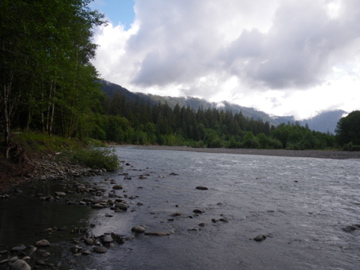
What a difference a year makes. I went for a nice long hike a couple days ago to see if I could find a few summer runs. The river was about twice as high as a week earlier last summer. The fishing was poor with limited visibility, but sometimes the trip is as important as the fishing.
I sometimes think that those of us that live in the Northwest have short memories when it comes to weather. The cold and non-existent spring and early summer faded from memory with the recent warm weather. The heart pushed hard to do a summer trip even though the mind knew the folly.
The differences between years were not only noticeable in the increased river flows but in the vegetation on the hike upriver. A year ago the thistle was head high and in bloom while this year the thistle was barely knee high and not even close to flowering.
The warm weather may have caused temporary weather amnesia in my head, but the stream-side vegetation and water level couldn't forget the cold spring and early summer.
Thursday, June 16, 2011
The Best Hatchery...
Northwest Voices - Elwha and Sol Duc
"Free-running rivers, always have been, always will be, the best hatchery."
"Hatcheries don’t mitigate dam devastation, they double it down."
Kudos to John Farrar for speaking out against damaging hatchery practices and for wild fisheries. It is nice to see some guides speaking out.
"Free-running rivers, always have been, always will be, the best hatchery."
"Hatcheries don’t mitigate dam devastation, they double it down."
Kudos to John Farrar for speaking out against damaging hatchery practices and for wild fisheries. It is nice to see some guides speaking out.
Saturday, June 11, 2011
Genetically Different
The common argument in favor of broodstock hatcheries is that the fish they put into the river are genetically the same as the native fish in the river. These hatcheries use only wild fish for brood.
How genetically similar are these fish. There is plenty of science stating that first generation hatchery fish are changed solely by being in the hatchery environment.
Taking away the changes from being raised in concrete, are wild broodstock a good place to start when looking to replicate wild genetics in a hatchery environment. One study from Oregon shows how much we have to learn about wild steelhead and genetics.
Wild rainbow trout critical to the health of steelhead populations
This study shows that "up to 40 percent of the genes in returning steelhead came from wild rainbow trout, rather than other steelhead." While the number may be higher in Hood River than in coastal rivers (it may be less) it shows how much genetic material is added by resident rainbows to the steelhead population. Not only should this be a call for more restrictive regulations on trout fishing in all coastal rivers but it should make us rethink whether we can ever hope to recreate wild steelhead genes in a hatchery environment. The Snider program on the Sol Duc is a prime example. Like all hatcheries, they use a small number of adult wild steelhead to create many hatchery fish. This narrows the gene pool in the returning hatchery fish which are allowed to spawn if not harvested (no trapping of returning hatchery adults happens) and pass that narrow gene pool on to future generations along with having reduced productivity. If one of these hatchery X wild or hatchery X hatchery crosses returns and then is used as broodstock the genetics shrink even more. By using only steelhead for the brood, one is excluding possibly 40% of the genes of the native fish.
We have a chance on the Sol Duc to remove a damaging hatchery program and designate the healthiest steelhead river left as a wild gene bank. This is truly an opportunity we cannot miss out on. We have until June 30th to send in our comments to snidercreek@dfw.wa.gov. The Native Fish Society has also put together an easy way to support the removal of this damaging program. Click the link below to comment.
http://alerts.nativefishsociety.org/campaign/4-snider-creek
How genetically similar are these fish. There is plenty of science stating that first generation hatchery fish are changed solely by being in the hatchery environment.
Taking away the changes from being raised in concrete, are wild broodstock a good place to start when looking to replicate wild genetics in a hatchery environment. One study from Oregon shows how much we have to learn about wild steelhead and genetics.
Wild rainbow trout critical to the health of steelhead populations
This study shows that "up to 40 percent of the genes in returning steelhead came from wild rainbow trout, rather than other steelhead." While the number may be higher in Hood River than in coastal rivers (it may be less) it shows how much genetic material is added by resident rainbows to the steelhead population. Not only should this be a call for more restrictive regulations on trout fishing in all coastal rivers but it should make us rethink whether we can ever hope to recreate wild steelhead genes in a hatchery environment. The Snider program on the Sol Duc is a prime example. Like all hatcheries, they use a small number of adult wild steelhead to create many hatchery fish. This narrows the gene pool in the returning hatchery fish which are allowed to spawn if not harvested (no trapping of returning hatchery adults happens) and pass that narrow gene pool on to future generations along with having reduced productivity. If one of these hatchery X wild or hatchery X hatchery crosses returns and then is used as broodstock the genetics shrink even more. By using only steelhead for the brood, one is excluding possibly 40% of the genes of the native fish.
We have a chance on the Sol Duc to remove a damaging hatchery program and designate the healthiest steelhead river left as a wild gene bank. This is truly an opportunity we cannot miss out on. We have until June 30th to send in our comments to snidercreek@dfw.wa.gov. The Native Fish Society has also put together an easy way to support the removal of this damaging program. Click the link below to comment.
http://alerts.nativefishsociety.org/campaign/4-snider-creek
Friday, June 10, 2011
Always Wrong
I attended the Snider Creek meeting in Forks earlier this week. Testifying in favor of the guide welfare program was the city attorney of Forks. I was reminded of a couple other fishery issues and the position Forks took (or pushed) and realized that they are always on the wrong side of the issue.
The wild steelhead retention moratorium was stopped because the City of Forks fought hard against it. They were wrong as wild steelhead numbers continue their downward slide.
Then I remembered going to meetings regarding halibut when I ran a charter boat. The City of Forks was actively pushing to open closed areas and start the season later in May. All of the charter boats stated that these ideas would only work to shorten the season which wouldn't benefit anyone. What happened since those rules were put in place. First, the halibut fishery is often open for less than a week's worth of days compared to three weeks to a month when these meetings took place. None of the charter boat captains who attended those meetings are running boats out of Neah Bay or La Push anymore. Forks in this case was wrong again when it came to managing fisheries.
Now Forks is pushing to keep the Snider Creek broodstock hatchery program open without additional restrictions. Seems to me we should look back at their history of being 100% wrong on fisheries management and totally disregard their opinion on this hatchery.
The City of Forks is incapable of making a good decision when it comes to our fisheries.
Also, how much of the Sol Duc runs through incorporated Forks? None... which should be the amount of sway they have on this decision considering their past when it comes to fisheries.
The wild steelhead retention moratorium was stopped because the City of Forks fought hard against it. They were wrong as wild steelhead numbers continue their downward slide.
Then I remembered going to meetings regarding halibut when I ran a charter boat. The City of Forks was actively pushing to open closed areas and start the season later in May. All of the charter boats stated that these ideas would only work to shorten the season which wouldn't benefit anyone. What happened since those rules were put in place. First, the halibut fishery is often open for less than a week's worth of days compared to three weeks to a month when these meetings took place. None of the charter boat captains who attended those meetings are running boats out of Neah Bay or La Push anymore. Forks in this case was wrong again when it came to managing fisheries.
Now Forks is pushing to keep the Snider Creek broodstock hatchery program open without additional restrictions. Seems to me we should look back at their history of being 100% wrong on fisheries management and totally disregard their opinion on this hatchery.
The City of Forks is incapable of making a good decision when it comes to our fisheries.
Also, how much of the Sol Duc runs through incorporated Forks? None... which should be the amount of sway they have on this decision considering their past when it comes to fisheries.
Wednesday, June 1, 2011
Lights Out
This morning at 8am the Elwha dams will no longer generate electricity.
One more step on the way to seeing the Elwha River flow free.
Elwha Dams stop generating electricity
One more step on the way to seeing the Elwha River flow free.
Elwha Dams stop generating electricity
Subscribe to:
Posts (Atom)