This morning I decided to head out for some local saltwater fishing. I didn't wake up early or rush to the water and missed my favorite tide change but sometimes getting out is enough.
It was a beautiful sunny day with not a breath of wind. The rainshadow was in full force with low clouds to the west, thicker clouds to the east, and big puffy clouds building over the Olympics.
The fishing was slow for everyone but I did have a quick pulse of action. I hooked a tiny chinook (eight inches) and as it got close to the kayak I could see six or seven coho swirling around it trying to eat it. The coho were keyed up and after I slipped the hook from the shaker chinook I quickly flipped the fly ten feet from the boat. One strip and I could see the coho take the fly. I set the hook and felt weight but the fly did not stick. I could still see the fish swimming under the kayak as I quickly flipped the fly back into the water. Just as quickly as before I had a coho on the end of the line and just as quickly it came unhooked. I so wanted to inspect the fly and make sure the hair wasn't fouled but I knew these fish would be gone as quickly as they appeared so I roll cast the fly back into the water. One strip and another of the coho inhaled the fly and turned. This time the hook held and I was able to quickly land the fish. I wish I could say that the action remained hot, but that was the last I saw of any adult salmon.
I'll try to remember this beautiful warm sunny day on the water in a couple months when it is cold, wet, and gloomy.
Wednesday, August 31, 2011


Tuesday, August 30, 2011
The Rise
Sitting in the sun on that gravel bar seems like a lifetime ago. It was blazing hot and buggy. Almost hard to believe I was on a coastal river. The sun was directly overhead which meant the tall mountains rising from each side of the river offered no escape.
The only refuge from the heat was standing in the river. If you are forced to stand in the river to cool off you might as well be fishing. The common wisdom is that bright sunny days with clear water are not ideal for steelhead on a floating line so I figured I would practice my spey casting.
I waded right into the main part of camp water. There was no quiet approach to the water or starting at the top of the run. There was no methodically working line out a few feet at a time until a comfortable length of line is out and starting to step down. I stripped out the amount I wanted to fish and sent the riffle hitched muddler across the river.
The fly came tight and started waking across the current moving towards shore. The bright light made tracking the fly easy and I casually watched it as it moved out of the fastest water and into a bit slower water mid way through the swing. Then I saw it.
A chrome fish coming straight up towards the fly. I could see the entire fish as it quickly moved up and engulfed the fly. No hesitation in snatching the fly as it appeared to rise in a straight vertical line from the cobbles to the surface before turning back to the depths with the fly.
Years later I cannot remember how this fish fought. All I can remember was the rise.
The photo of the fish brings back the memory of the rise as if it happened yesterday.
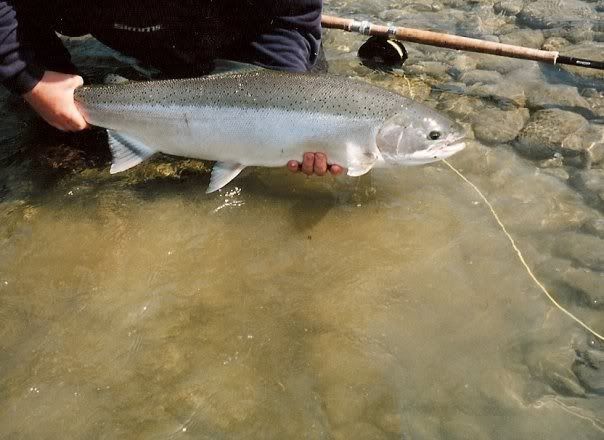
The only refuge from the heat was standing in the river. If you are forced to stand in the river to cool off you might as well be fishing. The common wisdom is that bright sunny days with clear water are not ideal for steelhead on a floating line so I figured I would practice my spey casting.
I waded right into the main part of camp water. There was no quiet approach to the water or starting at the top of the run. There was no methodically working line out a few feet at a time until a comfortable length of line is out and starting to step down. I stripped out the amount I wanted to fish and sent the riffle hitched muddler across the river.
The fly came tight and started waking across the current moving towards shore. The bright light made tracking the fly easy and I casually watched it as it moved out of the fastest water and into a bit slower water mid way through the swing. Then I saw it.
A chrome fish coming straight up towards the fly. I could see the entire fish as it quickly moved up and engulfed the fly. No hesitation in snatching the fly as it appeared to rise in a straight vertical line from the cobbles to the surface before turning back to the depths with the fly.
Years later I cannot remember how this fish fought. All I can remember was the rise.
The photo of the fish brings back the memory of the rise as if it happened yesterday.
Monday, August 29, 2011
Appalling Tribal Fishing
"With $20 million invested in the restoration of Tarboo Creek, it is
time to allow more salmon to survive the fishing nets, swim up the
stream and lay their eggs to produce even more coho and chum salmon.
That's the bottom line for Peter Bahls of Northwest Watershed Institute, along with others who have worked hard for 10 years to make Tarboo Creek more hospitable for salmon. But Bahls worries that all the efforts to restore the Hood Canal stream in Jefferson County will be for naught if current harvesting practices continue."
The rest of the story is below:
Concerns Raised Over Tarboo Creek Salmon
A Salmon Stream Worth Protecting
Salmon Must Survive To Swim Up Little Streams Too
Truly a shameful chapter in harvest management that almost all of the user groups, including the majority of the tribal co-managers, agree with a simple rule change that would protect this small population but one tribe can override it all.
How is this stewardship?
That's the bottom line for Peter Bahls of Northwest Watershed Institute, along with others who have worked hard for 10 years to make Tarboo Creek more hospitable for salmon. But Bahls worries that all the efforts to restore the Hood Canal stream in Jefferson County will be for naught if current harvesting practices continue."
The rest of the story is below:
Concerns Raised Over Tarboo Creek Salmon
A Salmon Stream Worth Protecting
Salmon Must Survive To Swim Up Little Streams Too
Truly a shameful chapter in harvest management that almost all of the user groups, including the majority of the tribal co-managers, agree with a simple rule change that would protect this small population but one tribe can override it all.
How is this stewardship?
Sunday, August 28, 2011

Abundance
The Osprey Steelhead News Blog recently had a great post about an article on the Elwha dam removal and hatcheries.
"Instead managers and the tribe appear willing to abandon the notion that wild fish, in a pristine watershed can support sustainable well managed fisheries." This quote seems to sum up my feelings about the over reliance on hatcheries not only on the Elwha but throughout the Pacific Northwest.
We seem to forget that wild fish can create abundant fisheries with little help from us. What seems funny to me is that it is an odd year which means it is the biannual pink salmon run in Washington State. While pinks have far different habitat requirements than coho, chinook, and steelhead they show us what abundance looks like. Not only do they show us abundance but they are showing us that wild fish can colonize and fill habitat very quickly. If you look at WDFW's SaSI reports you see that in 2002 there wasn't a pink salmon stock listed for the Green River. Now the Green has the largest pink salmon run in Puget Sound. A river with dams, major development, and superfund sites in the estuary gets a return of over two million pink salmon this summer.
Whether it is pinks, Oregon Coastal coho, Siletz summer steelhead, or Wind River summer steelhead the evidence of the ability of wild fish to recover in the absence of hatcheries is staring us in the face. It is too bad so many of those who make decisions ignore it.
"Instead managers and the tribe appear willing to abandon the notion that wild fish, in a pristine watershed can support sustainable well managed fisheries." This quote seems to sum up my feelings about the over reliance on hatcheries not only on the Elwha but throughout the Pacific Northwest.
We seem to forget that wild fish can create abundant fisheries with little help from us. What seems funny to me is that it is an odd year which means it is the biannual pink salmon run in Washington State. While pinks have far different habitat requirements than coho, chinook, and steelhead they show us what abundance looks like. Not only do they show us abundance but they are showing us that wild fish can colonize and fill habitat very quickly. If you look at WDFW's SaSI reports you see that in 2002 there wasn't a pink salmon stock listed for the Green River. Now the Green has the largest pink salmon run in Puget Sound. A river with dams, major development, and superfund sites in the estuary gets a return of over two million pink salmon this summer.
Whether it is pinks, Oregon Coastal coho, Siletz summer steelhead, or Wind River summer steelhead the evidence of the ability of wild fish to recover in the absence of hatcheries is staring us in the face. It is too bad so many of those who make decisions ignore it.
Thursday, August 25, 2011
What We Have Lost
As a followup to the post about the Elwha hatchery hurting wild fish recovery after the dams come down you should watch this video about the wealth of natural abundance we once had along the Strait of Juan de Fuca. Especially interesting are the comments about how many salmon used the lower five miles of the Elwha River before the spawning gravel eventually vanished with no upriver recruitment.
A healthy, intact Elwha can produce far more salmon than a hatchery.
A healthy, intact Elwha can produce far more salmon than a hatchery.
Subscribe to:
Posts (Atom)